Build a "Cowork recipe" library for your org
A great Cowork task someone ran once dies with them. Captured as a reusable recipe, it becomes something the whole team reruns on demand — multiplying one person's best workflow across everyone.
Stage: Cowork · For: Champion · Level: Intermediate · Time: 15 min
When to use this
Someone on your team figured out the perfect Cowork hand-off — "pull last month's support emails, theme them, draft a top-5 deck" — and it saved them half a day. Right now that knowledge lives in one person's head. A Cowork recipe library captures these multi-step task descriptions as reusable, documented recipes the whole team can rerun. It's the difference between a clever one-off and an organizational capability — the exact move that made Sean Galliher's Cowork Cookbook so useful.
This is a champion's scaling play: you're not doing the work, you're packaging the best workflows so everyone runs them without reinventing the prompt.
What you'll need
- M365 Copilot license with Cowork access across the team
- A few proven tasks worth capturing — workflows people already run and would rerun
- A home for the library — a SharePoint page, a Teams tab, or a simple shared doc
Try it now — the prompt
Turn a known workflow into a documented, reusable recipe:
Draft 5 reusable Cowork task descriptions for a [finance] team. For each, give
it a clear name, the exact task description to paste, the inputs it needs, and
the deliverable it produces — so anyone on the team can rerun it cold.
Why this works: a recipe needs four things to be rerunnable by someone who didn't write it — a name, the paste-ready description, the required inputs, and the expected output. Asking for all four turns a vague "Cowork can do X" into a recipe a teammate can run without you in the room.
Step by step
- Harvest the proven workflows first. Start from tasks people already run successfully — a recipe nobody asked for gathers dust. Mine your team's actual wins.
- Write each as a four-part recipe. Name, paste-ready description, inputs, deliverable. The inputs line is what people skip — and it's what makes a recipe reliably rerunnable.
- Put it where the team works. A SharePoint page or Teams tab they can browse and copy from. A library nobody can find is a library nobody uses.
- Keep it alive with a contribution loop:
Screenshots
Captured live in Microsoft 365 Copilot (Work mode). The product UI moves fast — if what you see differs, trust the numbered steps above, which we keep current.
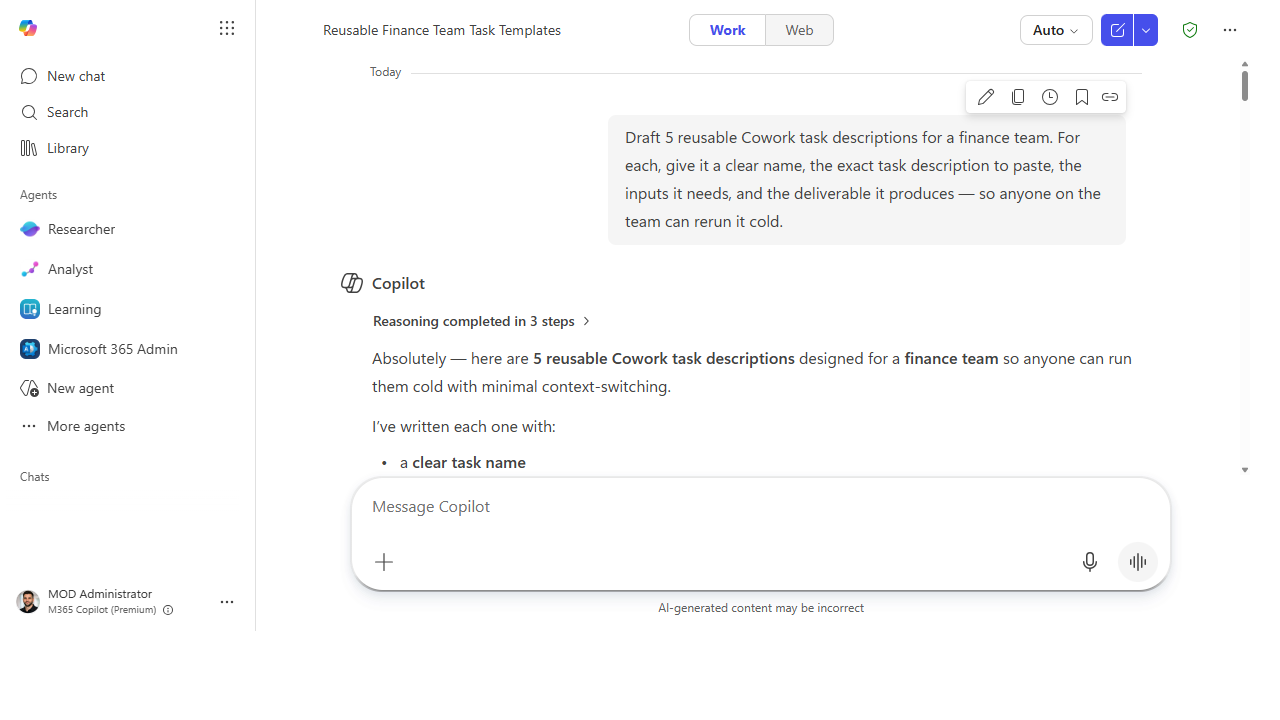 Ask Copilot to draft reusable, paste-ready task recipes for a whole team.
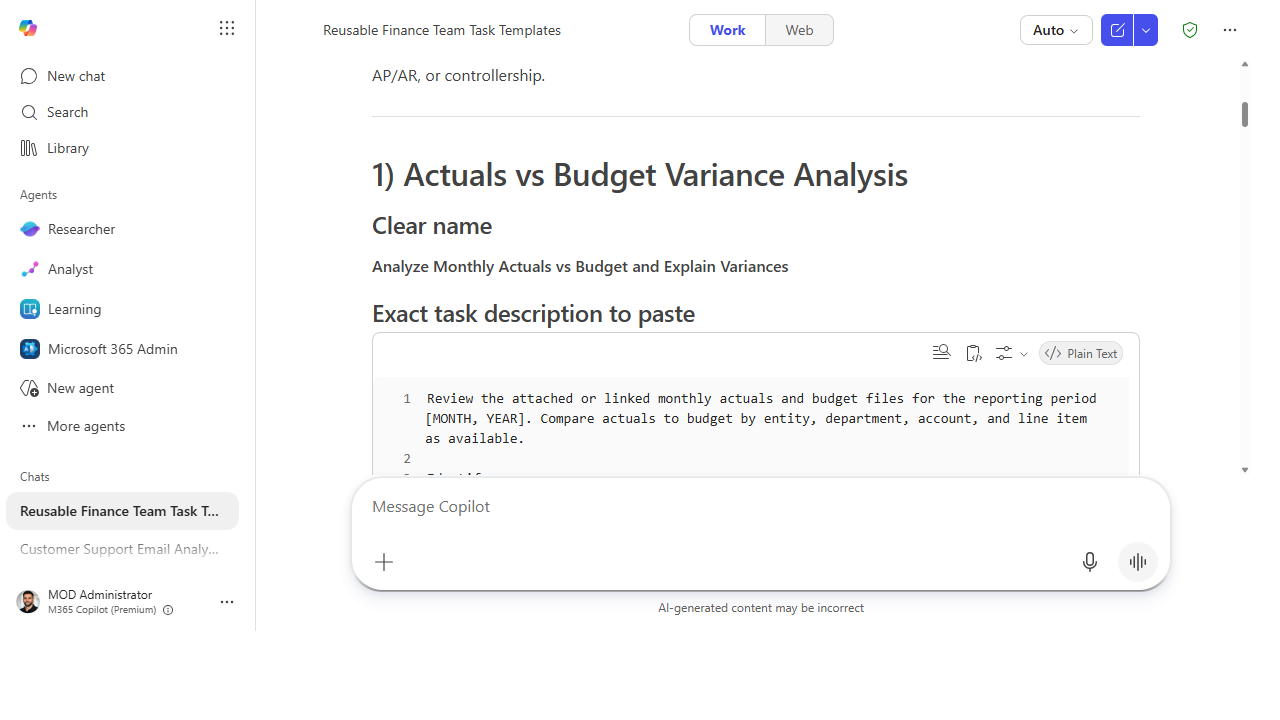 Each recipe comes back with the four parts that make it rerunnable cold — a clear name, the exact task description to paste, the inputs it needs, and the deliverable it produces.
Make it better
A recipe library is a living asset, not a one-time doc: - Stand on Sean's shoulders. Rather than rebuild from zero, point your team at the Cowork Cookbook's process-based recipes and adapt the ones that fit — then add the ones unique to your org. - Tag by role and process. "Finance · month-end," "Support · weekly themes." Findability is what turns a library into a habit. - Promote the heavy hitters. The recipe everyone reruns is a candidate to graduate into a scheduled Cowork task — or, later, a purpose-built agent. The library is your backlog for what to build next.
📚 Learn more. Sean Galliher's Cowork Cookbook (community, unofficial) is the model for a process-based recipe library — link your team to it and adapt — and the M365 Copilot resources hub (CAT) collects Microsoft guidance on getting the most from the broader Copilot experience.
Watch out for
- Recipes rot. Tools, sources, and team processes drift. A recipe that worked in Q1 may mislead by Q3 — assign owners and a review cadence, or the library quietly becomes wrong.
- Inputs are the failure point. Most "it didn't work for me" reports trace to a missing or misunderstood input. Document inputs ruthlessly; that's where reusability lives or dies.
- Don't over-curate. A perfectly governed library nobody contributes to beats a messy one everyone uses — never. Bias toward growth and tidy as you go.
Where this leads (the ramp)
A captured recipe is a Cowork skill — a reusable capability the whole team can rerun, not a one-off. And a recipe you rerun constantly is begging to become something you don't have to rerun at all. Once a Cowork workflow is stable and repeated, the next move is to build it — an agent that owns the job instead of a task you keep kicking off. That's Stage 4 · Agent Builder: your first declarative agent.
Next: Agent Builder → Build a "team knowledge" agent over a SharePoint site
Related
- Cowork → Hand off an end-to-end task to Cowork — the flagship task worth capturing
- Cowork → Stand up a recurring weekly digest — where a heavy-hitter recipe graduates to scheduled
- Stage 3 Resources: see
RESOURCES.md→ Cowork
Thanks — glad it helped. Spotted something to improve anyway? Suggest it →
Sorry this didn't land. Tell us what broke → so we can fix that rung of the ramp.
Found an issue or want to suggest an improvement? Open a GitHub issue · Star on GitHub